
How Subsequent Boundary Impact Modern Land Ownership
Have you ever looked at a world map and wondered why borders sit where they do? Why is one country shaped like a perfect square, while another country has jagged, squiggly lines?
Borders do not just appear out of nowhere. Geographers use spatial analysis to understand these lines. Spatial analysis is just a phrase for studying how locations and human patterns affect our lives.
Subsequent Boundary: Simple Definition, Examples & Comparisons
Have you ever looked at a world map and wondered why borders sit where they do? Why is one country shaped like a perfect square, while another country has jagged, squiggly lines?
Borders do not just appear out of nowhere. Geographers use spatial analysis to understand these lines. Spatial analysis is just a big phrase for studying how locations and human patterns affect our lives.
Some borders were drawn on empty land before many people lived there. But other borders were drawn much later. These lines were made after people had already built their homes, towns, schools, and ways of life.
This second kind of border is called a subsequent boundary. It is a major idea in political geography, which is the study of how borders, power, and people connect. In this guide, we will break down what a subsequent boundary is in plain language, explore real history stories, and see how it compares to other types of borders.
What is a Subsequent Boundary? Definition & Characteristics
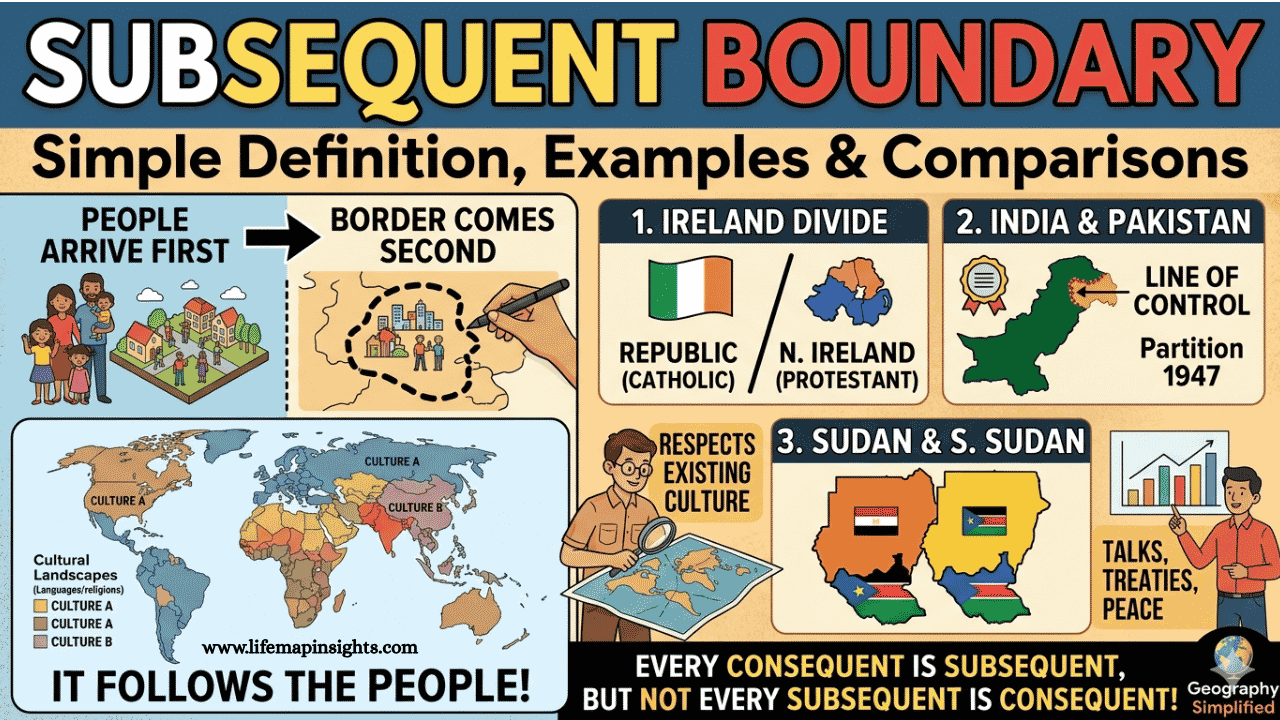
A subsequent boundary is a political border drawn after a large group of people has already settled in an area. To say it simply: the people arrive first, and the border comes second.
This is very different from a line drawn across an empty desert or a forest where no one lives yet. When mapmakers create a subsequent boundary, they have to look at the human landscape.
They try to follow the real patterns of where people already live. They look at where groups speak different languages, follow different religions, or share different histories.
Think of a subsequent boundary like a formal region. A formal region is an area where everyone shares the same trait, like a language or a local law. When leaders draw a subsequent boundary, they are usually trying to trace a line around an existing formal region.
Why Do Subsequent Boundaries Happen?
Most of the time, these borders are made through talks, treaties, or peace agreements. Two or more groups of leaders will sit down with population maps. They try to find a line that feels fair to everyone.
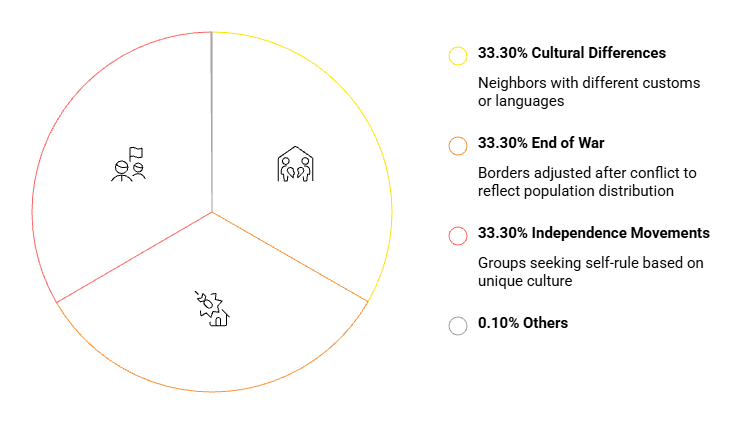
Here are a few reasons why a subsequent boundary gets drawn:
- Cultural differences: Two groups of neighbors realize they have different customs or languages. They decide they want separate governments.
- The end of a war: After a fight, nations might shift their borders to match where their citizens actually live. This helps keep the peace.
- Independence movements: A smaller group inside a big country decides they want to rule themselves based on their unique culture.
Of course, this process is almost never perfect. Human beings do not live in perfectly neat boxes. Different communities are often mixed together in the exact same towns and neighborhoods.
When a line is drawn, it can accidentally split families, cut off farmlands, or leave a minority group on the wrong side of the border. This is why even a boundary meant to respect culture can sometimes cause tension.
Real-World Examples of Subsequent Boundaries
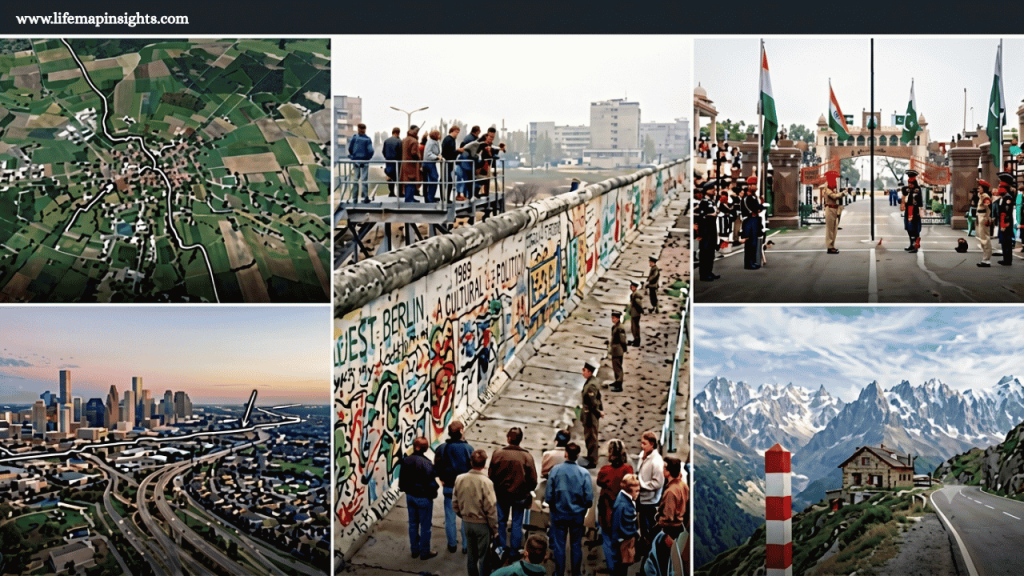
To really understand this concept, it helps to look at history. Let’s explore three famous examples where the people settled the land long before the final lines were drawn on the map.
1. The Island of Ireland: Republic of Ireland and Northern Ireland
For hundreds of years, the island of Ireland was home to two main groups of people with different identities: Catholics and Protestants. Over time, these groups settled in different numbers across the island.
In the early 1900s, political leaders decided to divide the island into two parts to address these differences:
- The Republic of Ireland: The southern and larger part of the island, where the vast majority of people were Catholic.
- Northern Ireland: The northeastern corner of the island, where a majority of the population was Protestant and wanted to remain part of the United Kingdom.
2. The Line of Control (India and Pakistan)
In 1947, the British Empire left South Asia. This region was a massive cultural hearth. A cultural hearth is a place where major cultures, ideas, and religions first begin. This area was home to hundreds of millions of Hindus and Muslims who lived in various communities.
When the land was split into two independent nations—India and Pakistan—leaders had to draw new borders through areas where people already lived. In the northern mountain region of Kashmir, a ceasefire line was drawn after a war broke out. Today, this is known as the Line of Control.
It acts like an international border, separating parts of Kashmir controlled by India from parts controlled by Pakistan. Because it was placed over an already deeply populated, ancient cultural landscape, it fits the definition of a subsequent boundary.
3. The Divide Between Sudan and South Sudan
For decades, the country of Sudan in Northeast Africa experienced deep internal divisions. The people living in the northern part of the country were largely Arab and Muslim.
Meanwhile, the people living in the southern part belonged to many different African ethnic groups, spoke different languages, and mostly practiced Christianity or traditional religions.
After years of struggle, the people of the south voted to form their own country. In 2011, South Sudan officially became the world’s newest independent nation.
The new border between Sudan and South Sudan was drawn specifically to separate these two very different cultural populations. The cultures were there for generations; the border came later.
Subsequent vs Consequent Boundaries
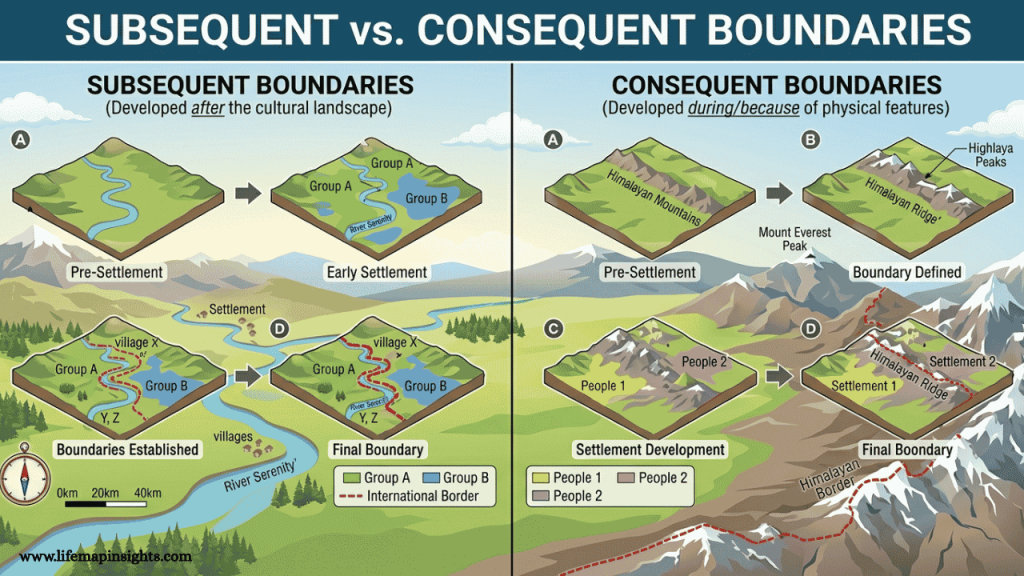
When studying geography, you will often hear the terms subsequent boundary and consequent boundary used in the same lesson. They sound almost identical, and they are closely related, but there is a small difference that is very important to know.
A subsequent boundary is the broad umbrella term for any border made after people settle.
A consequent boundary (also called an ethnographic boundary) is a specific type of subsequent boundary. It is drawn for the exact purpose of separating people based on a clear cultural difference, like language or religion.
The Golden Rule: Every consequent boundary is a subsequent boundary, but not every subsequent boundary is a consequent boundary.
Read more: Consequent Boundary
Side-by-Side Comparison
Comparing Boundary Types
| Feature | Subsequent Boundary | Consequent Boundary |
| When is it drawn? | After people have already settled the land. | After people have already settled the land. |
| What is the main goal? | To create a border based on general settlement history. | To specifically separate two distinct cultural groups. |
| What does it follow? | Can follow rivers, historical claims, or broad regions. | Follows cultural lines like language, religion, or ethnicity. |
| Real-World Example | The general borders of European countries over time. | The 1947 religious partition line between India and Pakistan. |
Comparing Other Political Borders
To master political geography, you need to see how subsequent boundaries contrast with the other main ways geographers classify borders. Let’s look at the three other major types.
Antecedent Boundaries
An antecedent boundary is a border that was drawn before a large human population ever moved into the area. Imagine drawing a line across a blank, empty map of a forest. Years later, people move to the area, build towns, and have to follow that pre-existing line.
- The Big Difference: With an antecedent boundary, the border comes first and the people come second. With a subsequent boundary, the people come first and the border comes second.
- Example: The border between the United States and Canada along the 49th parallel was drawn through wilderness long before big cities were built there.
Superimposed Boundaries
A superimposed boundary is a border that is forced onto an area by an outside power, like a conquering empire or a colonial government. The people who live there have no say in where the line goes. The outside rulers do not care about the local languages, religions, or tribal histories. They just draw the line wherever they want.
- The Big Difference: A subsequent boundary tries to respect and follow existing cultures. A superimposed boundary ignores existing cultures and cuts right through them.
- Example: In the late 1800s, European countries carved up the continent of Africa at the Berlin Conference. They drew straight lines that tore apart unified kingdoms and forced enemy tribes into the same countries.
Relic Boundaries
A relic boundary is a border that does not officially exist anymore as a political division, but you can still see evidence of it on the ground. It leaves a lasting mark on the cultural and economic landscape.
- The Big Difference: Subsequent boundaries are active, living borders that control where countries end and begin. Relic boundaries are historical ghosts.
- Example: The Berlin Wall once separated East and West Germany. Even though Germany reunited and the wall is gone, you can still look at satellite photos or economic data to see the differences between the two sides.
Conclusion
Borders shape how our world works every single day. In AP human geography, studying these lines is about more than just maps. It helps us see how different groups of people live, share resources, and survive.
When mapmakers draw lines after communities already live somewhere, they must be very careful. A bad border can take away good farmland and cause major problems like poverty.
However, a good border respects communities that have already established separate cultures. Knowing these boundary types is a great way to do well in APHG and truly understand world history!