
How a Consequent Boundary Shapes Our World
In AP (Advanced placement) Human Geography, we study political boundaries. Leaders might draw a straight geometric boundary or create a consequent boundary to separate different cultural groups.
To study these borders, geographers use a scale of analysis. They look at a local scale of analysis like a town, or a regional scale of analysis like a state. They also study a formal region, where people share traits that began in a cultural hearth.
Borders affect daily life. Geographers measure physiological density to see how many people live on farmable land. These characteristics help us see why countries fight or get along.
Defining the Consequent Boundary
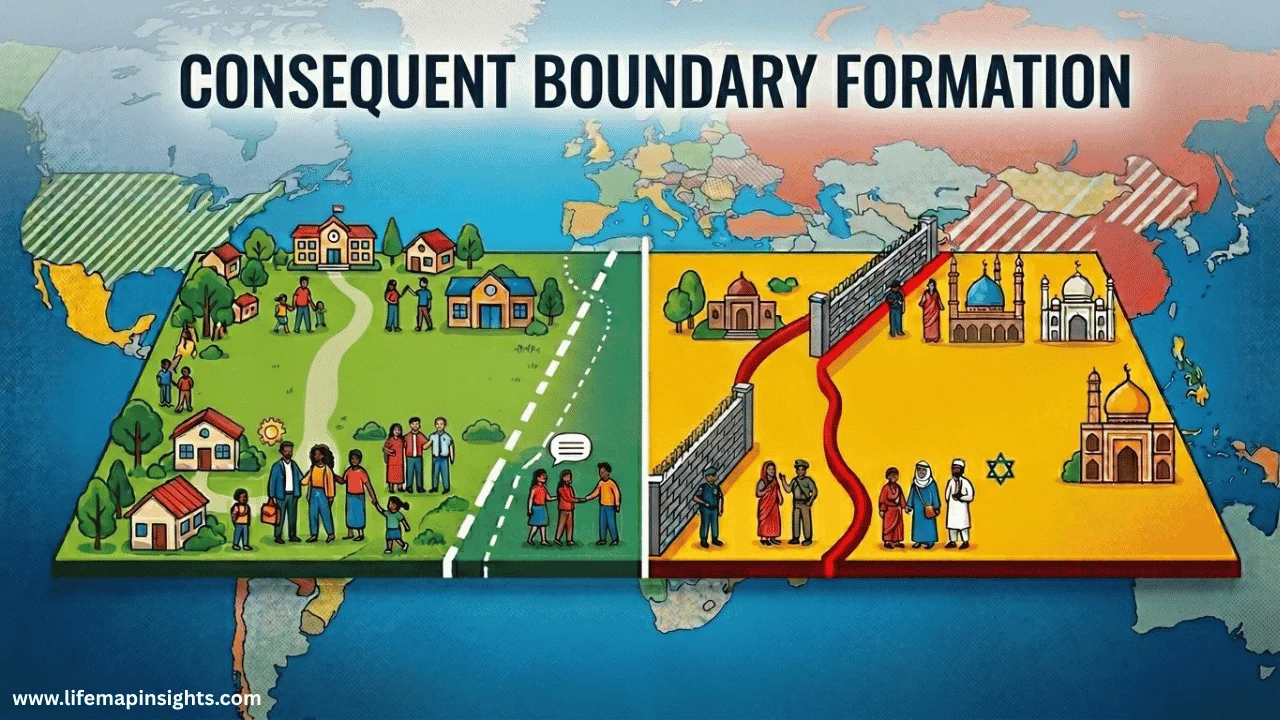
A consequent boundary is a political boundary made after people already live in an area. The main characteristic of this border is that it fits the cultural groups who live there.
Instead of drawing a straight geometric boundary that splits people up, leaders look at where groups naturally live. A consequent boundary follows the real lines of where people are.
This helps stop fighting. When borders match the people living there, it helps keep things peaceful because groups can stay together.
Read more: Antecedent Boundary
The Four-Fold Genetic Border Classification System
To truly understand a consequent boundary, we have to look at the bigger system geographers use to sort borders. This system splits borders into four groups based on how they were born. Looking at these four types shows us exactly how different lines interact with human history and change how people live.
Antecedent Boundary
An antecedent boundary is drawn before many people live in an area. It usually goes through wild, empty land. As people move in, they build their towns around this border line. A great antecedent boundary example is the border between the U.S. and Canada.
Superimposed Boundary
A superimposed boundary is forced on an area by a powerful outside country. This border completely ignores the local people’s religion or language. It often forces enemies to live together or splits families apart.
Relic Boundary
A relic boundary is a border that is no longer official, but you can still see it on the land. A famous relic berlin wall example shows how an old border can still change how people live and think today.
Subsequent and Consequent Boundaries
A subsequent boundary is made after people have already settled and created their own communities. When this line is drawn specifically to separate different cultural groups, it is called a consequent boundary.
Political, Cultural, and Spatial Characteristics
A consequent boundary has a special mix of natural shapes and human characteristics. This unique mix makes them look and act completely different from straight lines on a map or purely physical borders.
Socio-Political Foundations
At its core, a consequent boundary is all about the cultural groups living in an area. Even though the border becomes a real law, the main goal is to separate different groups of people. These political boundaries are usually made to separate groups with deep differences, like:
- Religion: Dividing groups with different beliefs to stop fighting.
- Language: Matching borders with the language people speak to make government easier.
- Ethnic Groups: Giving different groups their own space to live.
A consequent boundary is rarely forced by just one powerful country. Instead, leaders look closely at maps of where people live to negotiate and draw the lines together peacefully.
Physical Features and Geometric Deviations
Many people think a border must be either physical or cultural. In reality, a consequent boundary often uses nature to separate different groups. Over a long time, things like big mountains and wide rivers keep people apart.
This causes groups on different sides to develop their own unique cultural identities. When these become official political boundaries, the border is both physical and cultural.
This makes a winding, curvy border. It is the exact opposite of a geometric boundary. Geometric lines are just straight lines drawn on a map that ignore the land and the people. Because a consequent boundary follows real groups of people and natural barriers, it is almost never straight.
Delimitation and Demarcation Process
Like all official borders, a consequent boundary is made in three steps:
- Definition: Leaders talk and agree on the basic rules for the border line based on cultural records.
- Delimitation: Mapmakers officially draw the twisting line onto a legal map to make sure it protects different neighborhoods.
- Demarcation: Workers build the actual border on the ground. It can be a simple stone marker or a highly fortified demarcated boundary with fences, concrete walls, and checkpoints.
The 1947 Partition of India and Pakistan
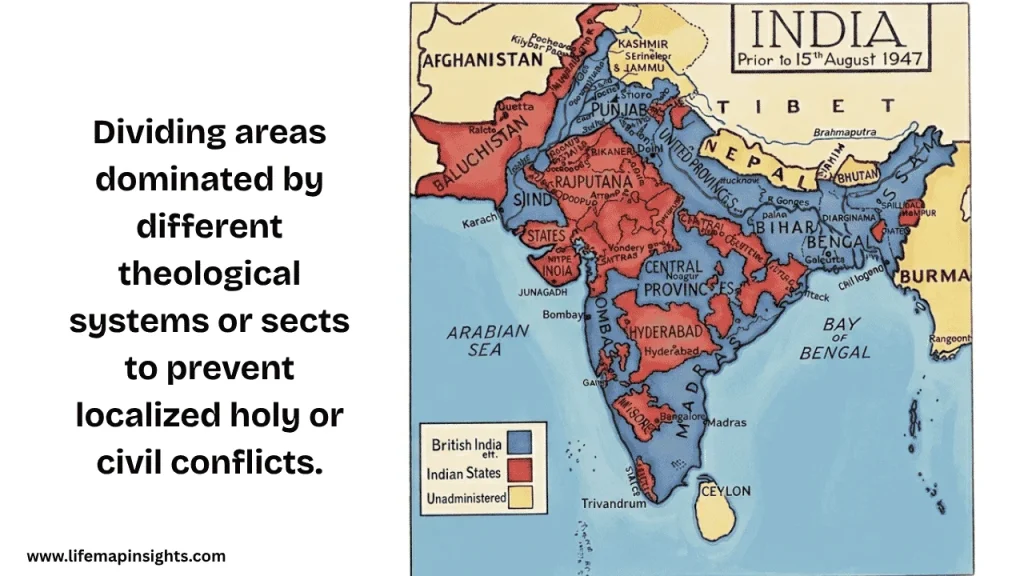
The division of British India in 1947 is a famous consequent boundary example. When British rulers left, the local people disagreed on how to run the country. There were deep religious differences between Hindus and Muslims. Leaders worried that keeping everyone in one country would cause a massive war.
A British official named Sir Cyril Radcliffe drew lines to separate the areas by religion. This created a mostly Hindu India and an Islamic Pakistan. This is a classic consequent boundary because the border was meant to match the cultural layout of where different religious groups lived.
However, this change caused terrible trouble. The border lines were drawn too fast using bad maps. Millions of people suddenly found themselves on the “wrong” side of the new political boundaries. This forced 15 million people to leave their homes in a rush, leading to widespread fighting and violence.
| Dimension of Partition | India | Pakistan |
| Main Group of People | Mostly Hindu and Sikh | Mostly Muslim |
| How the Line Was Decided | Religious groups in each district | Religious groups in each district |
| Type of Government Made | Secular Republic (Separates church and state) | Islamic Republic (Based on religion) |
The Modern Function of the Korean Demilitarized Zone (DMZ)
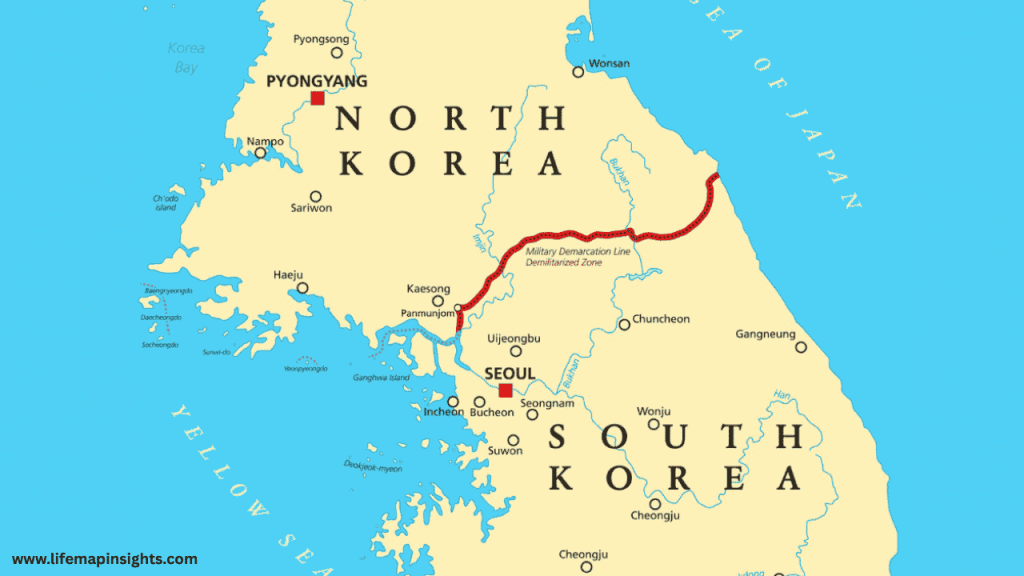
The border between North and South Korea has a unique history. When the Korean War ended in 1953, big outside countries like the U.S. and China drew a line to divide the land. At first, this was a superimposed boundary. It was forced on the people, cutting right through a group that shared the exact same language and culture.
However, after more than seventy years of complete separation, the two sides have changed drastically. They now have completely different governments, ways of speaking, and daily lives.
Today, this border acts like a rigid consequent boundary. It is no longer just an old war line. Instead, it now separates two completely different cultural worlds that grew apart over time.
Comparative Analysis: Consequent vs. Superimposed
Understanding the operational differences between consequent and superimposed borders is essential for evaluating state stability and international conflicts.
| Border Metric | Consequent Boundary | Superimposed Boundary |
| Fits the Culture? | High; matches where groups already live. | Low; completely ignores the local people. |
| Who Wrote It? | Local leaders, citizens, or peaceful helpers. | Outside empires, powerful invaders, or rulers. |
| Shape of the Line | Winding and irregular to follow neighborhoods. | Straight, geometric boundary lines. |
| Risk of Fighting | Usually lower after the initial adjustment. | Very high; causes long-term civil wars and anger. |
Spatial Dynamics and Cultural Diffusion
Borders are not completely impermeable walls; they interact dynamically with the spatial processes that occur around them.
Contagious Diffusion and Border Permeability
Contagious diffusion is when an idea or culture spreads fast from person to person. Even when there is a strong political boundary, this spreading can blur the border lines.
Everyday language habits, music, and ideas easily spill across borders when people live close and talk to each other daily. This creates a mix of cultures at the border, softening the sharp cultural differences the line was originally made to separate.
Relocation Diffusion and Boundary Friction
Relocation diffusion happens when people move to a new place and bring their culture with them. When massive groups of people move, they can change the entire mix of people living near a border.
This change can cause an allocational boundary dispute. This is a fight where neighboring countries argue over resources like water or oil found right on the border line.
If a moving population changes the cultural mix of a border town, the original reason for drawing that border might no longer make sense. This can cause countries to demand new lines or changes to their political boundaries.
Conclusion
In APHG, a consequent boundary gives different groups their own space to prevent fights. It is a subsequent ap human geography border because it is made after people already live there.
Dividing people perfectly is hard. A border looks fine on a map, but it changes when it becomes a demarcated boundary with real walls on the ground.
Geographers use a local scale of analysis to study how this affects a single town. A government might draw a straight geometric boundary ap human geography style.
However, citizens often live by a perceptual region based on their shared feelings and culture. The official ap human geo definition of a border is simple, but the real impact always changes.