

Top 7 Antecedent Boundary Examples Around the World Now
Imagine drawing a line on an empty map before anyone lives there. That is an antecedent boundary. Sometimes, mapmakers just use a straight geometric line, like a ruler on paper.
But what happens when people already live there? That is when we look at consequent vs subsequent borders.
From ancient walls that became a relic to every modern ap human geography example, these lines change how our whole world grows.
What does antecedent boundary mean in AP human geography?

An antecedent boundary is a border that was made before people settled the land around it. The word “antecedent” means “coming before.” So an antecedent boundary is a line that was there first. The people and towns came later. This kind of border is not based on cities, languages, or groups of people. It is often based on something simple, like a river or a straight line on a map.
You will see this idea a lot in antecedent boundary AP Human Geography lessons. It is one of the easiest ways to compare how borders are made. Teachers often ask students to tell it apart from subsequent, superimposed, and relict boundaries.
The antecedent boundary definition is simple: it is a line drawn before people built up the land, not a line drawn to match the people already there. Once you understand this, the rest of the boundary types make a lot more sense.
Key Characteristics of Antecedent Boundaries
The main trait of an antecedent boundary is timing. It forms before a place has very many people living there. Since there is no big population to think about, mapmakers often pick something easy to see, like a river or a mountain. If there is no clear physical feature, they might just use a straight line of latitude or longitude instead.
Here are some common characteristics of this type of border:
- It forms before a lot of people move into the area.
- It is often based on physical geography, like rivers or mountains.
- It tends to last a long time and stay stable.
- It is shaped less by conflict between groups, since the culture has not formed yet.
- Many old, early-mapped borders were made this way.
These borders tend to last because no one is fighting over them when they are made. A border that causes conflict right away often gets changed. But a line drawn before people settle the land usually stays the same for a very long time.
7 Antecedent Boundary Examples
1. The 49th Parallel Border (United States–Canada)
This is one of the most common antecedent boundary examples you will see. It is a straight line that follows the 49th parallel. Leaders agreed on this line before most people had settled the western parts of either country. Because the line came first, this is seen as a classic example.
2. The Gadsden Purchase (United States–Mexico Border)
This part of the border came from an early land deal. The deal was based more on land and growth than on people already living there. The line was set before much building happened in the area, so it counts as an early political division.
3. The Boundary Waters Region
Part of the U.S.-Canada border follows lakes and rivers in this area. This shows how a natural, water-based feature can shape a border. It is a good example of physical geography deciding where a line goes, instead of people deciding it.
4. Alaska–Canada Border
When this border was first drawn, very few people lived in the area. Many parts of it are simple, straight lines. This happened because there was no large population yet to think about.
5. Australian State Borders
Many borders between Australian states were drawn early using lines of latitude and longitude. At the time, most of the inland area had very few people. This meant there was little conflict when the lines were made.
6. Hadrian’s Wall
This is a much older example. Hadrian’s Wall was built by the Romans as a defensive wall long before later cultures changed the area. It shows that this kind of early boundary is not just a modern idea.
7. Native American Reservations
Many reservation borders were set by treaty before cities grew up around them. As towns and roads spread later, the original lines mostly stayed the same. This is a clear example of land being marked off early, before development.
A similar thing happened on Borneo. The line dividing parts of the island was drawn through thick rainforest long before many people lived there. This is another case where geography and early agreements decided the line, not the people living there.
Why the 49th Parallel Is an Antecedent Boundary Example
It helps to look closer at the 49th parallel, since it shows every trait of this type of border. It was set before most people moved into western North America, so the line came first. It is a straight line, which shows it was based on geometry, not on culture.
Two nations agreed to it through a treaty, not through fighting. And even after all the changes over the last 200 years, it is still used as a real international border today. Few borders show the “line first, people later” pattern as clearly as this one.
Antecedent Boundary vs Other Boundary Types
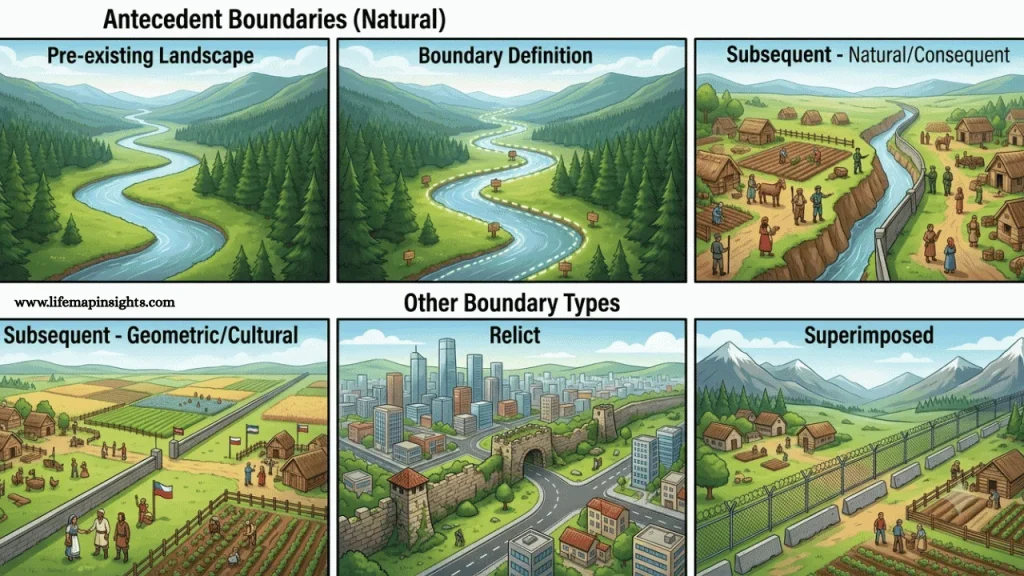
It is easier to understand boundaries when you compare them side by side. Most of the difference comes down to timing and the reason the line was drawn.
Subsequent Boundary AP Human Geography
A subsequent boundary forms after people have already settled the land and built a culture there. Instead of coming first, this kind of line is drawn to match real differences in religion, language, or ethnic groups.
The subsequent characteristics are almost the opposite of antecedent ones: culture comes first, then the border follows. The line between India and Pakistan is a common example, since it was drawn to separate groups that already had different religions.
Consequent Boundary Example
A consequent boundary is closely related to a subsequent boundaries. It is shaped to match cultural differences on purpose, with the goal of lowering conflict between groups. Instead of ignoring the people in the area, it is built around them.
Superimposed Boundary Example
A superimposed boundary works almost the opposite way. It is forced onto an area by an outside power, often without caring about the people already living there. African colonial borders are the usual superimposed boundary example.
European countries drew many of these lines without thinking about the ethnic or cultural groups split apart by them. This has caused conflict in the region for many years since.
Relict Boundary
A relict boundary is an old border that no longer works as a real political line, but you can still see traces of it in the land or culture. The relic Berlin Wall is the example most people know. Even though Germany has been one country again for decades, parts of the wall, and the path it once followed through the city, are still there today.
How Antecedent Boundaries Shape Regions
Antecedent boundaries do more than just mark a line on a map. They shape how whole regions grow over time. Because these borders are set early, they often help keep things politically stable. There is no large group on either side ready to fight over the line.
They also affect how towns and roads spread out later, since people build their lives around a border that is already there, instead of the border being built around the people.
In some cases, this early timing helps avoid conflict between cultures, since the border is not trying to split groups that already see themselves as separate.
But this can also cause problems. Since these borders were not made with culture in mind, they sometimes end up ignoring divisions that show up later. That can create tension down the road, even though that was not the original plan.
Over time, this is what makes antecedent boundaries such a useful topic to study. They show how one early choice, often based on nothing more than a river or a simple line of latitude, can shape a country’s borders for hundreds of years.
Whether the example is the 49th parallel, the line on Borneo, or a border drawn across the Australian outback, the same pattern shows up again and again: the geography and the agreement came first, and the people came after.