
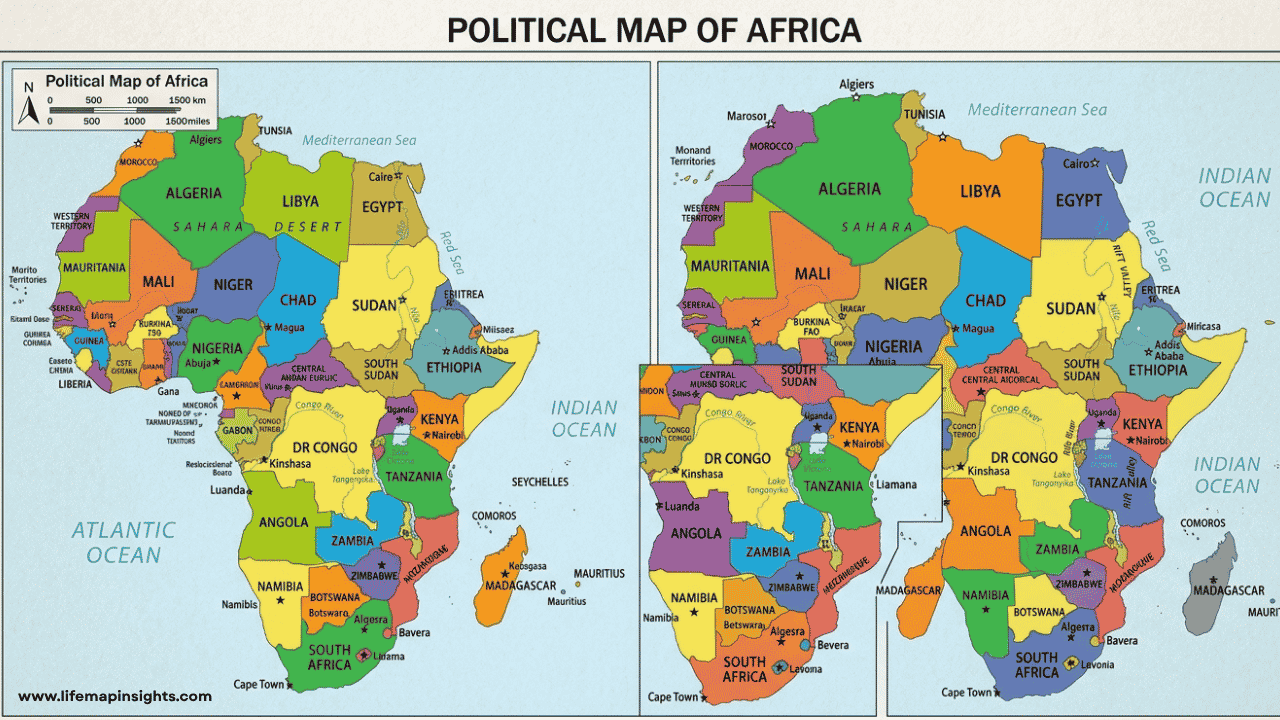
Africa political map points out major capitals
A Africa political map shows much more than just lines on paper. It shows where one country ends and another begins. It points out capital cities, massive metropolises, and the borders that shape how over a billion people travel, trade, and live their daily lives.
Whether you are working on a school project or just curious, learning to read a Africa political map is like getting a backstage pass to understanding 54 incredible nations!
Meet the African Continent
Africa is absolutely massive. It is the second-largest continent on Earth, both in land size and the number of people who live there. It is home to thousands of different cultures, hundreds of languages, and a wild mix of landscapes—from scorching deserts to thick, green rainforests.
Here are some quick facts to help you picture just how big it is:
| Fast Fact | The Details |
| Total Size | About 11.7 million square miles |
| Number of Countries | 54 recognized nations |
| Total Population | Over 1.4 billion people |
| Biggest Country | Algeria (by land size) |
| Most Crowded Country | Nigeria (by number of people) |
How History Shaped the Map
The borders on a modern Africa political map weren’t always there. Long ago, European countries drew these lines without asking the people who lived there. If you look at a World map of Africa, you can see how this shaped different areas.
These forced borders split up old communities and combined groups that didn’t get along. Today, a team called the African Union helps all these nations work together to keep the peace and boost trade.
Exploring the 5 Regions of Africa
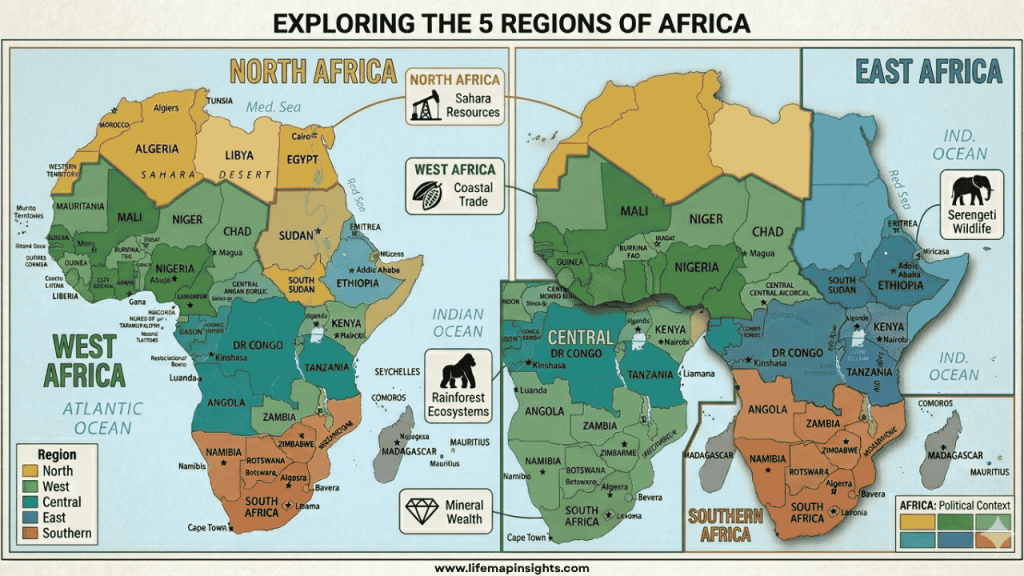
To make it easier to study, geographers usually split Africa into five main neighborhoods. Let’s take a quick tour!
1. North Africa
North Africa sits right along the Mediterranean Sea. It has deep roots in Arab and Berber cultures, and it shares a long history of trade with Europe and the Middle East. Egypt and Morocco are two huge players here, famous around the world for tourism, farming, and busy trade routes.
- What the map shows: If you look at a map of North Africa, you’ll see that the giant Sahara Desert stretches across almost every country, including Algeria, Libya, and Sudan. Because the desert is so dry and harsh, most people live in crowded, bustling cities right by the coast.
2. West Africa
West Africa is a lively region with a huge mix of cultures. Its economic powerhouse is Nigeria—the most populous country on the whole continent!
- What the map shows: West Africa is packed with 16 countries like Ghana, Senegal, and Ivory Coast. On a map, they look clustered tightly together along the coast. This means they share short borders and busy ocean ports, making it easy for neighbors to trade with one another.
3. Central Africa
Central Africa is the green heart of the continent. It is shaped by the massive Congo River and thick, dense rainforests. The Democratic Republic of the Congo is the biggest country here.
- What the map shows: While these beautiful, deep forests are home to amazing wildlife, they also make it much harder for people to build roads, travel, and trade.
4. East Africa
East Africa is home to the famous Horn of Africa and the Great Rift Valley—a giant crack in the Earth’s surface that stretches for thousands of miles. Kenya, Ethiopia, and Tanzania are major hubs for business, safaris, and farming.
- What the map shows: Along the coast, you’ll find the Swahili culture. For centuries, African, Arab, and Indian traders met here, creating a unique mix of food, music, and language that you can’t find anywhere else on Earth!
5. Southern Africa
Southern Africa sits at the very bottom tip of the continent. The region’s economy is anchored by the country of South Africa, which is famous for mining, farming, and big cities.
- What the map shows: South Africa actually has three different capital cities (Pretoria, Cape Town, and Bloemfontein)! Nearby neighbors like Namibia, Botswana, and Zimbabwe round out this region, featuring stunning deserts and world-famous wildlife parks.
Download Africa political Map PDF
Where Exactly is Africa?
Africa holds a very special spot on the globe. It is the only continent that sits right in the middle of the equator, with almost equal halves in the Northern and Southern hemispheres!
It is completely surrounded by water:
- West: The Atlantic Ocean
- East: The Indian Ocean
- North: The Mediterranean Sea
- Northeast: The Red Sea
Because it sits right in the middle of the world map, Africa has been a major crossroads for global trade and travel for thousands of years.
Map vs. Map: What are You Looking At?
Not all maps tell the same story. To truly understand Africa, it helps to look at different kinds of maps side-by-side.
Political Maps vs. Physical Maps
- A Political Map focuses entirely on human-made lines. It shows you exactly where one country’s government control ends and another begins. It’s built to show you borders, capitals, and major cities at a glance.
- A Physical Map strips away the country lines and shows you nature. This is where you can find giant mountains like Mount Kilimanjaro, huge deserts like the Sahara, and winding paths of rivers like the Nile.
Satellite Views and Google Earth
From outer space, Africa looks like a giant painting! Modern tools like Google Earth let you zoom from a view of the whole continent straight down to a single street.
Looking at satellite images shows a stark contrast: the top of Africa glows bright orange and brown from the dry Sahara Desert, while the middle is a solid band of deep green rainforest.
Wealth, Cities, and Big Challenges
Rich Resources
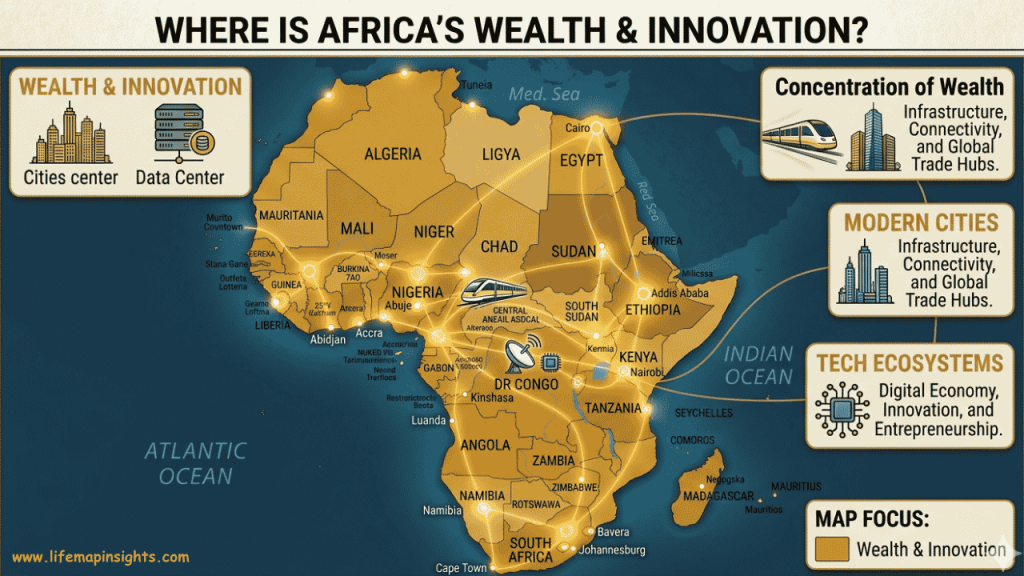
Africa’s political borders often line up with valuable treasures hidden in the ground. For example, Nigeria and Angola have large pools of oil.
Zambia is famous for copper mining, and South Africa is known worldwide for gold and diamonds. These natural resources have shaped the wealth and history of these nations for generations.
Mega Cities
Africa is home to some of the fastest-growing cities in the world. Cairo (the capital of Egypt) is a massive historic metropolis. Lagos (in Nigeria) is a booming hub for business and music. Johannesburg drives South Africa’s economy, and Nairobi is the high-tech center of East Africa.
Environmental Trouble
The continent faces some tough environmental challenges. In the zone just below the desert, a problem called desertification is happening—this is when healthy farmland turns into dry, unusable desert dust.
Conclusion
An Africa political map is more than just colors and lines. It is like a giant storybook! Those borders show the history of the land, while the major cities in Africa show a busy, growing place where over 1.4 billion people live.
When you look at a world map of Africa, you can see national capitals and different countries. These countries have to work together to use their resources, like the big Sahara Desert or the green Congo forests.
Every time you look at a map of Africa, remember that you are looking at a very important and exciting part of our world!