
What is Human Geography? Simple Guide for Students
Have you ever wondered why big cities like New York or Tokyo are so crowded, while other places like the Sahara Desert are almost empty? Or why you can find a fast-food restaurant like McDonald’s in almost every country around the world? This is what human geography is all about!
Simply put, human geography is the study of people, their communities, and how they interact with planet Earth.
You might already know about physical geography, which focuses on nature—like mountains, rivers, climates, and volcanoes. Human geography is different. Instead of studying the natural world, it studies the human world. It looks at where people live, the cultures they create, and how they change their environment over time.
What is Human Geography?
Simple Definition
Human geography is the study of the relationships between people and the places they live. It looks at how human activities shape the Earth’s surface and how the environment influences human behavior.
What do Human Geographers Study?
Human geographers study a wide range of topics. They look at population growth, how religions and languages spread, and how global economies work. They also study human behavior, migration patterns, and how societies develop and build cities over time.
Why is Human Geography Important?
It helps us understand the “why” behind the “where.” For example, why did early humans always build cities near rivers? Because they needed fresh water for farming, drinking, and trade.
Why is the English language spoken in so many different countries today? Because of historical migration and global business. By answering these questions, human geography helps us make sense of the world we live in.
Main Branches of Human Geography
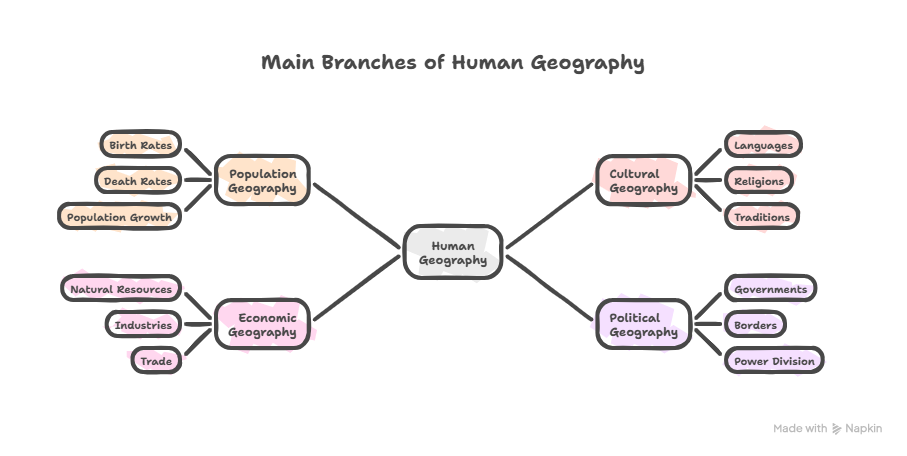
Human geography is a huge subject, so geographers break it down into smaller branches. Here are the five main ones:
1. Population Geography
This branch studies human populations. It looks at birth rates, death rates, and how populations grow or shrink in different areas.
- Real-Life Example: A geographer might study why a country’s population is aging fast and how that will affect their schools and hospitals in the future.
2. Cultural Geography
This is the study of human culture, including languages, religions, traditions, and food. It looks at how culture spreads from one place to another.
- Real-Life Example: Studying how pizza originated in Italy but is now a favorite food baked and eaten all over the world.
3. Economic Geography
Economic geography focuses on money, jobs, and trade. It looks at how natural resources are used, where industries are located, and how countries trade goods.
- Real-Life Example: Investigating why so many big technology companies and computer engineers are located in Silicon Valley, California.
4. Political Geography
This branch studies governments, borders, and how power is divided across the globe.
- Real-Life Example: Analyzing how drawing a new border line between two countries might cause political arguments or change international trade routes.
5. Urban Geography
Urban geography is all about cities (urbanization). It studies how cities grow, how neighborhoods change, and how people move around in them.
- Real-Life Example: Studying why terrible traffic jams happen in a growing city and how building a new subway train line could fix the problem.
Important Concepts in Human Geography
To understand human geography, you need to know a few big ideas. Here are the core concepts explained simply:
- Place and Space: “Space” is a general area on a map, but a “place” has special meaning to people. For example, your house is not just an empty space; it is a place filled with memories and a specific culture.
- Scale (Local, National, Global): Geographers look at issues in different sizes or scales. They might study a local neighborhood problem, a national election, or a massive global issue like climate change.
- Human-Environment Interaction: This is how humans change nature (like cutting down trees to build homes) and how nature affects humans (like building strong houses in areas with earthquakes).
- Migration and Diffusion: Migration is the physical movement of people from one place to another. Diffusion is how ideas, inventions, or cultural trends spread outward from their starting point.
- Globalization: This is the idea that the world is becoming much more connected. Because of the internet and fast airplanes, countries rely on each other for trade, information, and entertainment more than ever before.
Real Life Examples of Human Geography
Human geography is happening all around you every single day! Here are a few real-life examples:
Why Cities Grow (Urbanization)
Think about a small farming town that slowly turns into a massive city. As more factories and businesses open, people move there to find better jobs. This process of cities growing bigger is called urbanization.
Movement of People (Migration)
When people move from a rural village to a big city to find work, or when families move to a totally new country for a better life and education, they are creating spatial patterns of migration.
How Culture Spreads (Cultural Diffusion)
Have you ever watched a viral TikTok dance that started in another country? Or listened to K-Pop music from South Korea? That is cultural diffusion in action—ideas and art spreading across borders at lightning speed!
Impact of Humans on Environment
When a forest is cut down to build a new shopping mall, or when pollution from cars changes the air quality in a city, that is a direct example of humans altering their geographic environment.
Tools Used in Human Geography
How do geographers actually do their research? They use some very cool tools:
Maps and Cartography
Cartography is the science of making maps. Geographers use all kinds of maps to show population density, climate patterns, or even where different languages are spoken.
GIS (Geographic Information System)
Think of GIS as a super-smart digital map on a computer. It allows geographers to layer different types of data on top of each other—like showing a map of where rivers are, layered with a map of where floods happen most often.
Surveys and Field Work
Geographers don’t just sit at desks looking at screens. They go outside, talk to human communities, conduct surveys, and observe how people actually live in the real world.
Why Should You Study Human Geography?
You might be wondering, “Why do I need to learn this subject?”
- Helps Understand the World Better: It helps you understand global news, why conflicts happen, and why countries trade with each other.
- Useful for Future Careers: If you want to be a city planner, an environmental scientist, an architect, or an international business leader, you need human geography skills.
- Connection With Daily Life: It explains the world right outside your window, from the imported food in your grocery store to the languages your neighbors speak.
Conclusion
In conclusion, human geography is the fascinating story of us. It explores how we live, how we connect with each other, and how we leave our permanent mark on planet Earth. Every road you drive on, every building you enter, and every product you buy is part of this massive global web.
The Earth is our home, and understanding how we interact with it is the first step to making it a better, more sustainable place.
What did you learn today? Look out your window and see if you can spot an example of human geography in your own neighborhood. Share it in the comments below!